
About
The Provincial Infection Control Network of British Columbia (PICNet) is a provincial health improvement network (HIN) of the Provincial Health Services Authority (PHSA) that works to reduce health care-associated infections in BC health-care facilities.
Our key areas of focus are surveillance, evidence-informed guidelines, and education. PICNet works together with partners on provincial surveillance initiatives, development and promotion of infection prevention and control best practices, and the creation of educational and operational tools.
Our community of practice includes experts in infection prevention and control, occupational health and safety, public health, infectious diseases, patient safety and quality, microbiology laboratories, and others.
|
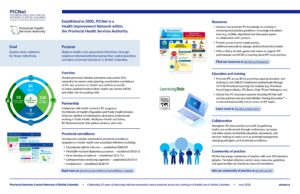
Click on the thumbnail below to download PICNet’s informational one-pager handout.
|
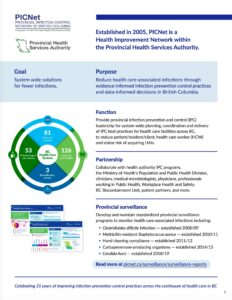
Click on the thumbnail below to download PICNet’s informational two-pager handout.
|
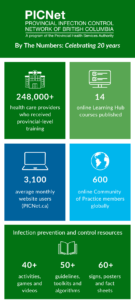
Click on the thumbnail below to download PICNet by the Numbers.
|
|
|
|
|
|
|
|
|
|
Click on the thumbnail below to download PICNet’s timeline two-pager handout.
|


WHAT PICNET CAN DO FOR YOU
As a network, PICNet works closely with the infection prevention and control Community of Practice. This includes taking requests for consultations, projects, and resources. Following are some ways that PICNet can help you:
- Develop new guidelines or manuals
- For example, the Residential Care Manual was developed following a request from the Community of Practice
- Review guidelines or policies you have developed from an infection prevention and control perspective
- Help you develop education modules or tools, or provide input on materials you have developed
- Put you in touch with experts in the field of infection prevention and control
- Direct you to the information you need (e.g. existing guidelines or standards, expert groups)
- Help you find infection control courses
- Provide consultation on infection prevention & control
- Provide education sessions tailored to your needs
For any of the above, feel free to email us to find out how to proceed.
VISION, PURPOSE AND VALUES
GOAL
System wide solutions for fewer infections.
PURPOSE
Reduce health care-associated infections through evidence-informed infection prevention control practices and data-informed decisions in British Columbia.
VALUES
| Value | Principle |
| Compassion | We act with cultural humility and support anti-racist IPC practice. |
| Equity | We make IPC knowledge accessible, inclusive, and reflective of diverse perspectives, upholding respect, equity and cultural safety. |
| Collaboration | We work in partnership – with respect, honesty, courage, and shared responsibility to strengthen IPC across BC. |
| Innovation | We use evidence and learn, reflect, and adapt to promote provincial IPC practices and processes. |
| People and Planet-focused | We commit to planetary health principles to ensure environmental responsibility in IPC practices, safeguarding people, communities and the health care system. |
PICNet Team
- Explore Our Team Members
- Reporting structure details will be available soon.
KEY PARTNERS/COMMUNITY OF PRACTICE
With support and guidance from our infection prevention and control partners in the health authorities across British Columbia, PICNet brings together health care professionals with an interest in infection control from across the continuum of care and across the province, including:
- Epidemiologists
- Infection Control Professionals
- Infectious Disease Physicians
- Medical Microbiologists
- Directors of Care
- Medical Health Officers
- Public Health Nurses
- Environmental Health Officers
- Occupational Health Nurses
- Occupational Health Physicians
- Other health-care providers
PROVIDING LEADERSHIP AND GUIDANCE
The overarching strategic objective for PICNet is to optimize sustainable capacity within the infection control community of practice. This means ensuring the best possible results are achieved within the available resources. This is achieved by PICNet:
- Providing advice on relevant policies and issues
- Providing knowledge to guide investigation and/or practice
- Supporting and coordinating initiatives that pull common interests together
- Sharing information
- Advocating on behalf of the community of practice for appropriate and sustainable resources
- Assisting and participating in surveillance activities