
April 22 Earth Day Celebration
The Provincial IPAC Planetary Health Interest Group is pleased to recognize Earth Day, celebrated each April 22, by showcasing how member led projects grounded in planetary health principles are being put into action across the health system in British Columbia.
The group co-chaired by Drs. Titus Wong and Victor Leung, brings together healthcare colleagues from across the province who share an interest in environmental protection and sustainable practice. PICNet provides administrative and knowledgesharing support for this provincial group, helping to reduce duplication of work across organizations.
Currently, group members are leading initiatives in infection prevention, procurement, and clinical practice. Through this work, teams are demonstrating that protecting planetary health and, by extension, improving human health can be achieved through a wide range of practical and scalable approaches.
The following examples highlight how members of the group are creating broader impacts across the healthcare landscape.
Interior Health: New Product Evaluation Matrix

Kathryn Bush
Kathryn Bush, IPAC director at Interior Health (IH), created a New Product Evaluation Matrix (the “BUSH Matrix”). This Planetary Health-informed decision support tool is used to guide product development and procurement by considering environmental impact alongside human health and system needs, early in the decision-making process. By embedding multidisciplinary perspectives into evaluation and purchasing decisions, this evaluation tool supports safer and more sustainable choices across the health system. The IH Sustainability team are important partners in this work as the teams continue to create a collaboration process for new initiatives.
Providence Health Care & Fraser Health: Glove use optimization

Dr. Victor Leung
The Providence Health Care (PHC) IPAC team, in collaboration with the Cardiac Surgery Intensive Care Unit at St. Paul’s Hospital, implemented a glove use optimization initiative known as the Glove Smart project. Implemented over six months, the project streamlined how gloves were used and disposed of within the unit, while still maintaining safe practice. At the conclusion of the pilot, overall glove use decreased by 53 percent, avoiding the use of more than 90,000 nonsterile gloves. This reduction was estimated to be equivalent to 2,342.6 kilograms of carbon dioxide equivalents and approximately 998 litres of gasoline.
Fraser Health is advancing work on appropriate glove use, building on learning from a pilot project completed in spring 2025. This initiative focuses on education and awareness-raising for appropriate glove use to reduce unnecessary waste while maintaining infection prevention and control standards. Building on the pilot’s success, several additional units are planned for further work in 2026 – including in acute, long-term care, and renal settings. This effort aligns with broader systemwide goals to reduce waste (financial and environmental) while emphasizing hand hygiene and strengthening sustainable practices across healthcare settings.
Providence Health Care: Gastroenterology Suite Practice Change
The GI clinic team at PHC, in collaboration with PHC IPAC team, transitioned from using sterile water to tap water for colonoscopy flushes. This teambased practice change eliminated an outdated approach and reduced unnecessary plastic waste and associated costs, while continuing to maintain patient safety.
First Nations Health Authority & Vancouver Coastal Health: Personal Protective Equipment (PPE) Expiry and Gown Revalidation Initiative
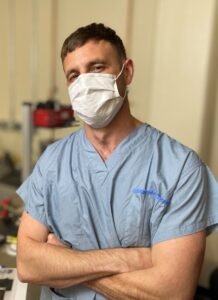
Jesse Cooper
Jesse Cooper, manager of the PPE Testing Laboratory at Vancouver Coastal Health (VCH), led a team that conducted laboratory testing of past-date gowns and respirators. Working in close partnership with First Nations Health Authority, this project included testing of past-date N95 respirators. Testing results have shown the respirators continue to meet performance requirements.
The VCH PPE Testing lab also led a largescale testing initiative of past-date AAMI Level 2 gowns across the PHSA supply chain inventory.
Early results indicate that 2.2 million gowns remained suitable for continued use as Level 2 gowns, while an additional 125,000 gowns met Level 1 requirements, despite being past their expiry dates. Retaining these products prevented unnecessary disposal and significantly reduced material waste.
Together, these examples illustrate planetary health as a shared approach that connects decisionsupport tools, frontline practice change, and systemwide stewardship.
This Earth Day, the IPAC Planetary Health Interest Group recognizes and thanks the individuals and teams whose leadership and collaboration are helping to build a healthier future for people and for the planet.
For more information, please reach out to PICNet if you want to be involved in the group or the great work occurring in the province.